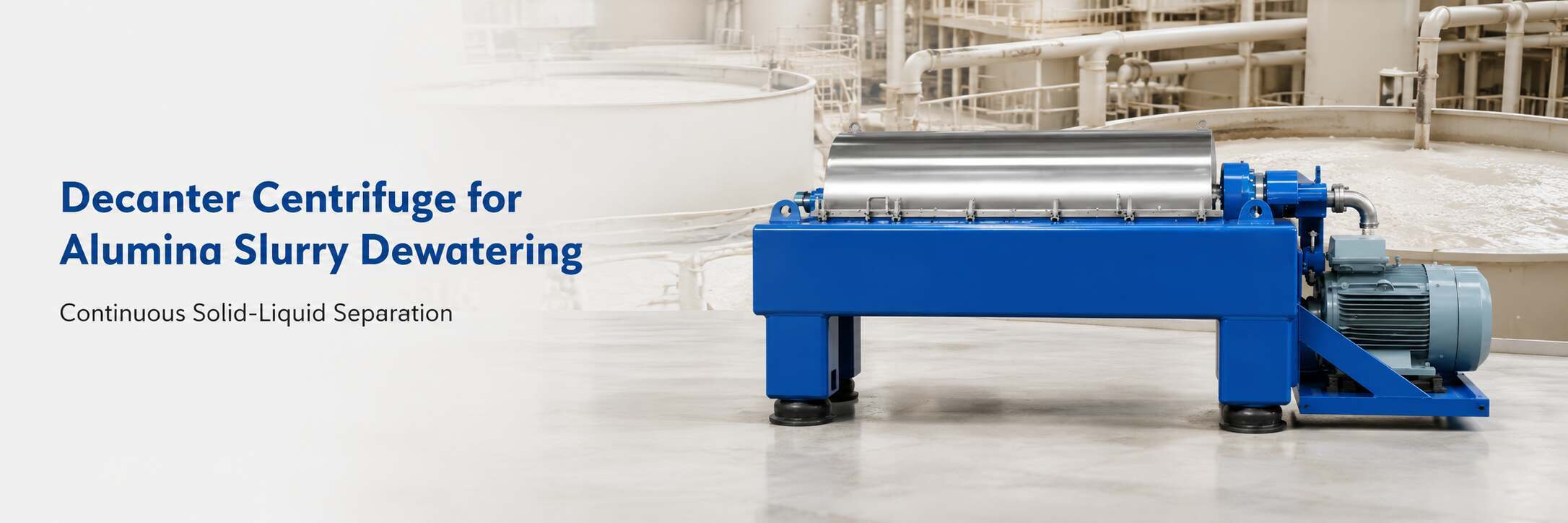
Decanter Centrifuge for Alumina Slurry Dewatering
Description
The Decanter Centrifuge for Alumina Slurry Dewatering is designed for continuous solid-liquid separation, slurry thickening, solids recovery, and process-liquid clarification in alumina and bauxite processing plants.
It can be used to treat alumina hydrate slurry, bauxite washing slurry, red mud slurry, precipitation slurry, classification overflow, and other fine mineral suspensions generated during alumina production.
Typical Applications
- Alumina hydrate slurry dewatering
- Red mud slurry thickening
- Bauxite washing-water clarification
- Fine bauxite particle recovery
- Bayer process residue treatment
- Precipitation slurry thickening
- Seed slurry concentration control
- Caustic liquor recovery
- Filter press feed thickening
- Process-water recycling
- Red mud washing and liquor recovery
- Fine mineral solids removal
- Alumina plant wastewater pretreatment
Why Use a Decanter Centrifuge for Talc Slurry?
|
Process Requirement
|
Decanter Centrifuge Solution
|
|
Continuous slurry treatment
|
Continuous feeding, separation, and solids discharge
|
|
Fine solids recovery
|
High centrifugal force for fine alumina and mineral particles
|
|
Caustic liquor recovery
|
Clarified liquid can be returned to the process
|
|
Variable slurry concentration
|
Adjustable bowl speed and differential speed
|
|
Abrasive mineral particles
|
Optional wear-resistant scroll and discharge protection
|
|
High alkalinity
|
Suitable wetted materials and alkaline-resistant seals
|
|
Lower filter press load
|
Slurry thickening before final filtration
|
|
Stable solids concentration
|
Automatic torque and differential-speed control
|
|
Reduced wastewater volume
|
Process-liquid recycling and solids concentration
|
|
Automatic operation
|
PLC and VFD-controlled continuous running
|
Alumina Slurry Dewatering Solution
Peony provides continuous solid-liquid separation solutions for alumina slurry dewatering, red mud thickening, mineral residue recovery, caustic liquor clarification, and process-water recycling.
Typical Process Flow
Bauxite Washing / Digestion / Precipitation / Residue Washing → Agitated Slurry Tank → Optional Dosing → Decanter Centrifuge → Thickened Solids → Further Processing / Storage
Clarified Liquid → Process Tank → Recycle
Peony Can Provide:
- Slurry testing and centrifuge selection
- Feed tank and pump system
- Optional dosing and dilution
- Adjustable operating parameters
- Wear-resistant and alkali-resistant design
- PLC automatic control system
- Integration with downstream equipment
- Installation and commissioning support
How the Decanter Centrifuge Works
1. Alumina Slurry Feeding
The slurry enters the rotating bowl through a controlled feed pipe. An agitated tank is usually used to keep solids suspended and ensure stable feed. Dilution or flocculant can be added if needed.
2. Centrifugal Sedimentation
High-speed rotation separates solids and liquid. Dense particles move outward to form a solids layer, while clarified liquid stays near the center.
3. Continuous Solids Conveying
A screw conveyor moves solids toward the conical section for further dewatering before discharge. Differential speed can be adjusted based on process needs.
4. Clarified Liquid Discharge
The liquid flows to the outlet and is discharged. It can be reused in the process or sent for further treatment. Liquid level can be adjusted to balance clarity and capacity.
5. Thickened Solids Discharge
Concentrated solids are continuously discharged and can be sent to filtration, drying, storage, or further processing.

Technical Parameter
| Model |
Diameter (mm) |
Length (mm) |
Length-to-diameter rate |
G force |
Max solid discharge (m³/h) |
Weight (kg) |
Dimension (L*W*H) (mm) |
| PDC-10 |
250 |
1000 |
4 |
4080 |
0.4 |
1000 |
2410*800*1080 |
| PDC-12 |
4200 |
1350 |
4 |
3500 |
0.6 |
1200 |
2610*800*1080 |
| PDC-12 |
4200 |
1350 |
4.5 |
3180 |
1.2 |
1800 |
3495*840*1180 |
| PDC-18 |
4000 |
1600 |
4.5 |
3180 |
1.2 |
3200 |
3497*1020*1385 |
| PDC-18 |
450 |
2150 |
4 |
2500 |
2 |
3800 |
4447*1080*1385 |
| PDC-20 |
400 |
2250 |
4.5 |
2500 |
3.5 |
4000 |
4580*1140*1470 |
| PDC-21 |
530 |
2280 |
4.3 |
2500 |
5 |
5000 |
4924*1170*1540 |
| PDC-26 |
655 |
2800 |
4.3 |
2270 |
8 |
7000 |
4300*1900*1350 |
Key Selection Considerations
Alumina Slurry Type
Identify the slurry source, such as alumina hydrate, red mud, or bauxite slurry. Different slurries have varying properties, so centrifuge selection should match the specific process stage.
Particle Size and Fine Content
Fine particles like alumina hydrate and clay may settle slowly. High ultrafine content can affect liquid clarity and require higher centrifugal force.
Slurry Solids Concentration
Feed concentration impacts capacity, torque, and separation performance. Stable feed conditions are recommended for consistent operation.
Alkalinity and Temperature
Some streams contain hot caustic liquor. Key factors like NaOH concentration, temperature, and chemical composition should be considered for material selection.
Abrasive Mineral Content
Hard particles such as silica and quartz can cause wear. Proper wear protection should be selected based on abrasive content and operating conditions.
Main Advantages
Continuous Alumina Slurry Dewatering
The decanter provides continuous feeding, separation, and solids discharge, ensuring stable operation for alumina slurry treatment.
Improved Process-Liquid Recovery
Clarified process water or caustic liquor can be recycled back into production, reducing liquid loss and fresh-water consumption.
Stable Slurry Thickening
Key parameters such as bowl speed and feed rate can be adjusted to achieve the required slurry concentration and discharge performance.
Lower Downstream Filtration Load
Pre-dewatering reduces liquid volume before filtration or drying, improving efficiency and reducing load on downstream equipment.
Suitable for Alkaline Process Conditions
Materials and components can be selected to withstand caustic environments, ensuring reliable operation under alkaline conditions.
What Data Is Needed for Selection?
Please provide the following information for a suitable alumina slurry dewatering solution:
- Process stage
- Slurry type (hydrate, red mud, bauxite residue, etc.)
- Particle size (incl. % <10 μm)
- Solids concentration & density
- Viscosity & temperature
- NaOH concentration & corrosive components
- Required capacity
- Target solids/moisture after separation
- Clarified liquid quality & recovery rate
- Abrasive particle content
- Flocculant type (if any)
- Downstream process
- Material & wear protection requirements
- Operating hours & electrical standard
- Automation level
- Installation space
FAQ
Can a decanter centrifuge dewater alumina slurry continuously?
Yes. A decanter centrifuge can continuously separate fine mineral solids from the liquid phase while feeding and discharging without frequent production stops.
Can it be used for red mud treatment?
Yes. It can be used for red mud thickening, residue-volume reduction, and caustic-liquor recovery. The centrifuge should be equipped with suitable wear protection because red mud may contain abrasive mineral particles.
Can clarified caustic liquor be recycled?
Yes. Depending on the liquid quality and process requirements, clarified liquor can be returned to washing, digestion, precipitation, or another recovery stage.
Is wear protection necessary?
Wear protection is normally recommended when the slurry contains silica, quartz, iron-rich minerals, unreacted bauxite, or other abrasive particles.
The required protection level depends on particle hardness, particle size, solids concentration, and operating hours.
Is flocculant dosing required?
Not always.
Flocculant may be required when the slurry contains a high proportion of ultrafine particles or when high clarified-liquid quality is required. Laboratory or pilot testing is recommended before confirming the dosing system.
Contact Peony for Partnership
Peony welcomes distributor and agent cooperation with alumina refineries, bauxite processing plants, mining companies, red mud treatment companies, mineral beneficiation contractors, industrial wastewater companies, and solid-liquid separation partners.
We support partners with slurry testing, decanter centrifuge selection, flocculant dosing design, wear-resistant configuration, process-water recycle integration, installation guidance, commissioning support, spare parts, and after-sales service.
Send us your alumina slurry information, including the process stage, slurry type, particle size, solids concentration, sodium hydroxide concentration, operating temperature, required capacity, liquid-recovery target, clarified-liquid requirement, abrasive-particle content, and downstream arrangement. Our engineering team will recommend a suitable decanter centrifuge and process solution for your alumina slurry dewatering application.