Top Discharge Centrifuge for Ceramic Bead Washing and Dewatering
Description
The Top Discharge Centrifuge is designed for batch washing, dewatering, and recovery of ceramic beads, grinding media, and wear-resistant ceramic particles.
It is suitable for dense granular materials such as alumina beads, zirconia beads, ceramic grinding media, ceramic pellets, and similar particles produced after forming, sintering, polishing, classification, or surface treatment processes.
Typical Applications
- Alumina bead washing and dewatering
- Zirconia bead recovery
- Ceramic grinding media separation
- Wear-resistant ceramic particle washing
- Ceramic pellet washing before drying
- Polishing media cleaning and recovery
- Removal of fine particles from ceramic bead slurry
- Ceramic bead dewatering after surface treatment
- Process water removal before screening or packaging
- Batch recovery of high-density ceramic particles
Ceramic Bead Washing and Dewatering Solution
Peony provides the batch solid-liquid separation section between ceramic bead washing and downstream drying, screening, or packaging.
Ceramic Bead Slurry Tank → Controlled Feed → Top Discharge Centrifuge → Initial Filtrate Collection → Optional Washing → Spin Drying → Manual Top Discharge → Dryer / Screen / Storage / Packaging
Peony can provide:
- Top discharge centrifuge matched to bead size and batch capacity
- Basket screen selection based on bead diameter and fines content
- Controlled feeding arrangement for stable bead loading
- Optional washing system for fines and residue removal
- Filtrate collection and recycle connection
- Wear-resistant basket and product-contact configuration
- PLC or manual control configuration as required
- Connection to downstream dryer, screen, conveyor, silo, or packaging line
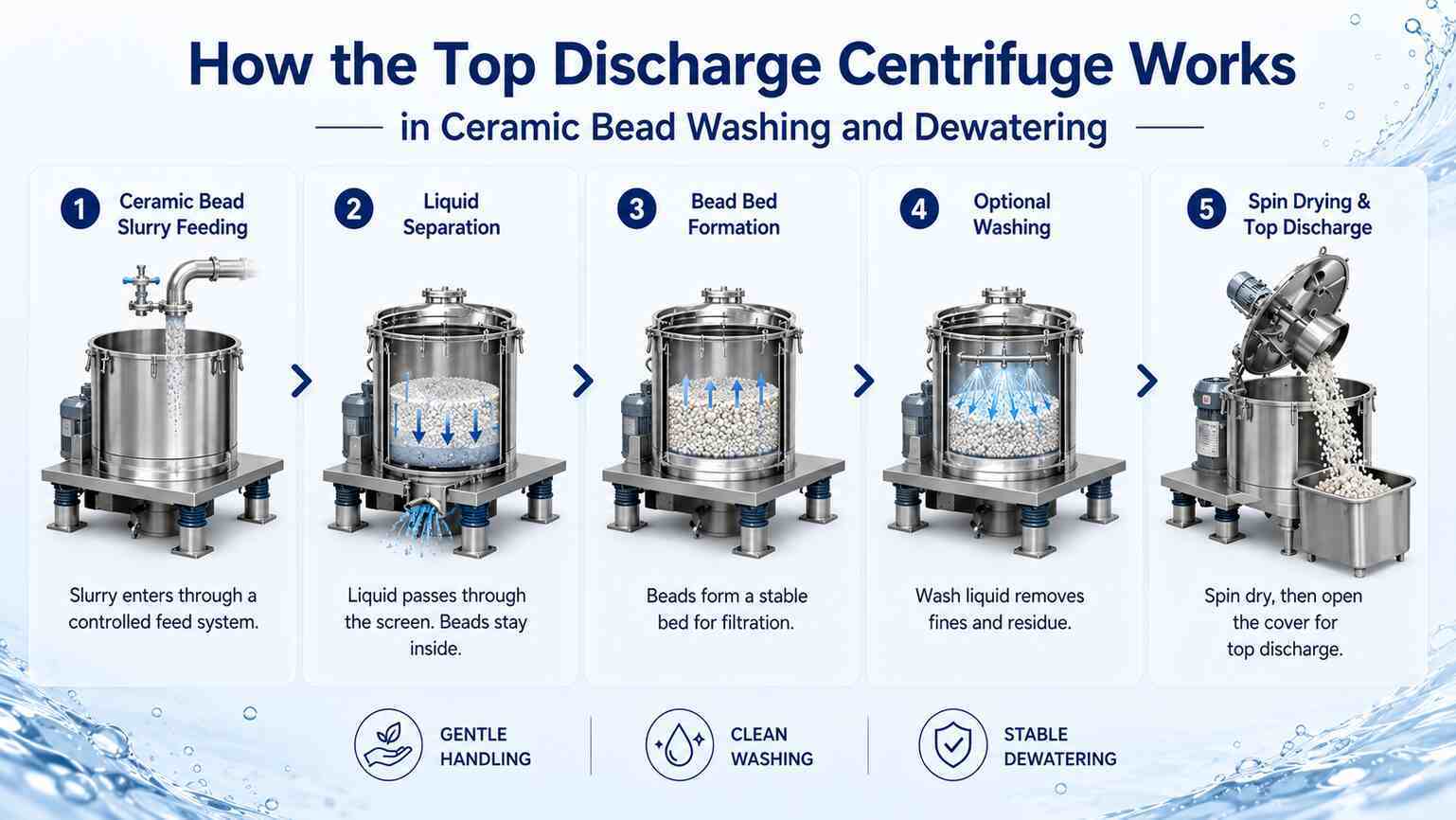
How the Top Discharge Basket Centrifuge Works in Ceramic Bead Washing and Dewatering
1. Ceramic Bead Slurry Feeding
Ceramic bead slurry enters the rotating basket through a controlled feed system.
The feed rate is adjusted to support even bead distribution and avoid excessive impact inside the basket.
2. Liquid Separation
Under centrifugal force, water or process liquid passes through the basket screen and is collected through the filtrate outlet.
The ceramic beads remain inside the basket.
3. Bead Bed Formation
The retained beads form a stable permeable bed.
Screen opening, bead size distribution, fines content, and slurry concentration affect filtration speed and filtrate clarity.
4. Optional Washing
Wash liquid can be introduced to remove residual process liquid, fine particles, polishing residue, or soluble impurities retained between the beads.
5. Spin Drying and Top Discharge
The basket continues rotating to reduce free liquid in the bead bed.
After the cycle is completed, the cover is opened and the dewatered ceramic beads are discharged manually from the top of the basket.
Technical Parameter
| Type |
Basket - Diameter (mm) |
Basket - Volume (L) |
Basket - Capacity (kg) |
Basket - Speed (rpm) |
Basket - G-force |
Power (kw) |
Weight (kg) |
Dimension (L×W×H) (mm) |
| PPTD-10 |
300 |
5 |
10 |
2500 |
1050 |
1.1 |
180 |
890×600×500 |
| PPTD-25 |
450 |
20 |
25 |
1900 |
910 |
1.5 |
250 |
980×650×870 |
| PPTD-50 |
600 |
40 |
50 |
1500 |
756 |
3 |
800 |
1300×880×900 |
| PPTD-135 |
800 |
100 |
135 |
1200 |
645 |
5.5 |
1300 |
1800×1200×1140 |
| PPTD-135-NA |
800 |
100 |
135 |
1500 |
1008 |
7.5 |
1300 |
1800×1200×1140 |
| PPTD-200 |
1000 |
150 |
200 |
1000 |
560 |
7.5 |
2000 |
2050×1500×1220 |
| PPTD-200-NA |
1000 |
150 |
200 |
1200 |
806 |
11 |
2000 |
2050×1500×1220 |
| PPTD-300 |
1200 |
250 |
300 |
800 |
431 |
11 |
2500 |
2350×1650×1370 |
Main Advantages in Ceramic Bead Washing and Dewatering
Reliable Bead Retention
The basket screen can be selected according to bead diameter and particle-size distribution to retain the main product fraction while reducing material loss.
Suitable for Abrasive Ceramic Materials
The centrifuge can be configured for dense and wear-resistant ceramic particles that may cause abrasion in standard separation equipment.
Effective Batch Washing
Optional washing helps remove fines, polishing residue, soluble salts, or remaining process liquid before drying or packaging.
Lower Moisture Before Drying
Spin drying reduces free water retained between beads, helping lower the load on downstream drying equipment.
Flexible Batch Handling
The top discharge structure is suitable for batch production, screen inspection, cleaning, product changeover, and different ceramic bead grades.
Screen and Wear Configuration
Ceramic beads are often dense and abrasive. The basket screen and internal components should be selected not only according to bead size, but also according to particle hardness, fines content, washing frequency, and expected operating hours.
Peony can evaluate:
- Screen opening and retention accuracy
- Bead diameter and size distribution
- Fines generation during washing
- Basket wear risk
- Need for replaceable screens or wear parts
- Required filtrate clarity
- Wash liquid flow rate and wash cycle
- Target moisture before drying
What Data Is Needed for Selection?
To recommend a suitable Top Discharge Centrifuge, please provide:
- Ceramic bead type
- Bead material, such as alumina or zirconia
- Bead diameter and particle-size distribution
- Fines content
- Bead bulk density
- Slurry solids concentration
- Process liquid composition
- Washing requirement
- Required batch capacity
- Target moisture after dewatering
- Required filtrate clarity
- Downstream dryer, screen, conveyor, or packaging arrangement
- Required material and wear-resistant configuration
- Control requirement, manual or automatic
FAQ
Can this centrifuge be used for alumina and zirconia beads?
Yes. It can be configured for alumina beads, zirconia beads, ceramic grinding media, and other dense ceramic particles when the basket screen is selected according to bead size and fines content.
How is the basket screen selected?
Screen selection depends on bead diameter, particle-size distribution, fines content, acceptable product loss, filtrate clarity requirement, and washing conditions.
Can the ceramic beads be washed inside the centrifuge?
Yes. An optional washing system can remove residual process liquid, fine particles, polishing residue, and soluble impurities before spin drying.
Is the centrifuge suitable for abrasive ceramic particles?
Yes. For abrasive bead materials, Peony can review the need for wear-resistant screens, replaceable components, and suitable product-contact materials.
Can the centrifuge connect to a dryer or screen?
Yes. The dewatered ceramic beads can be transferred to a dryer, vibrating screen, conveyor, storage bin, or packaging line according to the plant layout.
Contact Peony for Partnership
Peony welcomes distributor and agent cooperation with ceramic bead producers, grinding media manufacturers, advanced ceramic material companies, surface treatment plants, and industrial separation partners.
We support partners with centrifuge selection, basket screen matching, wear-resistant configuration, washing process design, filtrate recycle connection, installation guidance, commissioning support, spare parts, and after-sales service.
Send us your ceramic bead type, bead size, fines content, slurry concentration, washing requirement, target moisture, batch capacity, and downstream handling arrangement. Our engineering team will recommend a suitable Top Discharge Centrifuge solution and cooperation proposal.